Estate Cleanout in Charlotte: A Step-by-Step Checklist for Clearing a Family Home
Paperwork, valuables, donation, disposal, and what each phase actually costs
An estate cleanout in Charlotte runs in five phases, and they have to happen in order: settle the legal authority first, search for valuables second, sort room by room third, donate what a nonprofit will actually take fourth, and only then dispose of the rest. Families who skip straight to the fifth phase are the ones who throw away a savings bond, and families who never reach it are the ones still paying utilities on an empty house in February.
The disposal phase is where the money goes, and it is also the phase with the most Charlotte-specific rules. The City of Charlotte will collect a scheduled pile of household furniture from the curb at no separate charge, but it will not touch the drywall, shingles, or contractor debris that a whole-house clearout tends to produce. Mecklenburg County will take one bulky item free and charge you from the second item forward. A roll-off container in the driveway sidesteps both limits, and for a full house it is usually the cheapest hour-for-hour option. This guide walks the whole sequence with verified Charlotte numbers, in the order you will actually need them.
Key Takeaways
- Paperwork first. In North Carolina a personal representative is appointed by the clerk of superior court. In Mecklenburg County that office is at 832 East Fourth Street, and the filing fee is $120.
- Small estates have a shortcut. If the personal property is worth $20,000 or less and 30 days have passed since the death, the estate can often be collected by affidavit instead of full administration.
- Search before you sort. The three-hour valuables sweep is the highest paid work anyone does during a cleanout.
- Charlotte bulky pickup is free but narrow. It must be scheduled, and items placed at the curb without scheduling are not collected.
- The county’s free lane is one item. A second item moves you to $15 per unit for bulky waste, and $25 per unit for construction debris.
- A whole house is usually a 20 or 30-yard job. Rapid Haul runs $450 for a 20-yard and $545 for a 30-yard with 7 days included, which works out to $22.50 and $18.17 per cubic yard.
- Budget one to three weekends for a three-bedroom house with one crew of family members. Two weeks is a realistic calendar.
What’s in this guide
- The five phases, and why the order matters
- Phase 1: Legal authority before a single box moves
- Phase 2: The valuables sweep
- Phase 3: Sorting room by room
- The room order that keeps a crew moving
- Phase 4: What Charlotte nonprofits actually accept
- Phase 5: The disposal phase, and where the budget goes
- What the city and county will take off your hands
- What Charlotte will not collect from a cleanout
- Sizing a container for a whole house
- What an estate cleanout costs in Charlotte
- How long a whole house really takes
- Five mistakes that cost families the most
- Frequently asked questions
- The bottom line
The five phases, and why the order matters
Almost every expensive mistake in an estate cleanout comes from doing the right task in the wrong week. Selling the dining set before the will is probated can create a problem with the other heirs. Renting a container before the sorting is done means paying for days you spend deciding rather than loading. Booking a donation pickup before you know what the charity declines means loading a truck twice.
The sequence below is not a suggestion about how to feel. It is a work order. Each phase produces something the next phase needs: authority, then an inventory of what matters, then sorted piles, then an empty donation list, then a disposal plan sized to what is left. Families who run it in this order finish a three-bedroom house in about two weeks of evenings and weekends. Families who improvise tend to spend two months.
| Phase | What happens | Realistic time | What it produces |
|---|---|---|---|
| 1. Legal authority | Locate the will, get certified death certificates, apply at the clerk of superior court | 1 to 4 weeks, mostly waiting | Letters, or a small estate affidavit |
| 2. Valuables sweep | Search every hiding place before anything leaves the house | 3 to 6 hours | Cash, documents, jewelry, and the preliminary inventory |
| 3. Room-by-room sort | Keep, distribute, sell, donate, and toss piles, one room at a time | 1 to 2 weekends | Five staged piles and an honest volume estimate |
| 4. Donation | Confirm what each nonprofit takes, then schedule pickups or drop-offs | 1 to 3 weeks of lead time | A smaller disposal pile and a donation receipt |
| 5. Disposal | Curbside bulky pickup, county drop-off, or a driveway container | 1 to 7 days | An empty house |
Phase 1: Legal authority before a single box moves
This is the phase people skip, and it is the only one with legal consequences. In North Carolina, when property has to pass through the estate, a representative is appointed by the court to collect the assets, pay valid debts, and distribute what is left. That appointment happens in the office of the clerk of superior court, and until it happens nobody has formal authority to sell or give away the contents of the house.
To open an estate you visit the clerk of court in the appropriate county. The North Carolina Judicial Branch says to bring four things: the will if there was one, a certified death certificate, an application and preliminary inventory of the decedent’s property, and a $120 filing fee. Some clerks take walk-ins and some require an appointment, so call before you drive downtown.
Two practical notes before you go. Order more certified death certificates than you think you need, because banks, insurers, pension administrators, and the DMV each want their own certified copy and will not accept a photocopy. And start a single notebook for the whole cleanout on the same day, with one page per account, one page per heir, and one running list of what leaves the house and where it went. That notebook becomes the backbone of the inventory you owe the clerk, and it is far easier to keep from day one than to reconstruct in week three.

Where to file in Mecklenburg County
Estate filings for Mecklenburg County go through the Clerk of Superior Court at the Mecklenburg County Courthouse, 832 East Fourth Street, Charlotte, NC 28202. The clerk’s office is open to the public from 9:00 a.m. to 5:00 p.m., Monday through Friday, and the courthouse main line is 704-686-0400. Build the trip into a weekday. This is the one part of a cleanout you cannot do on a Saturday.
The small estate shortcut
Not every estate needs full administration. Under North Carolina’s small estate statute, when someone dies without a will leaving personal property worth no more than $20,000 after liens and encumbrances, and at least 30 days have passed since the date of death, the property can be collected by affidavit filed with the clerk of superior court in the county where the person lived. If the person filing is the surviving spouse and sole heir, the ceiling rises to $30,000, reduced by any spousal allowance already paid.
That threshold counts personal property, not the house. For a parent whose main asset was the home and whose furniture, car, and bank account together sit under the limit, the affidavit route can save weeks. Ask the clerk which path fits before you assume you are in for full administration.
The deadline nobody mentions
Once a personal representative qualifies, North Carolina gives them three months to return a sworn inventory of the estate’s real and personal property to the clerk, unless the clerk extends the time. That is the real reason the valuables sweep comes before the sorting: you are not just looking for treasure, you are building a court filing. Photograph anything of consequence before it moves, and keep the receipts from any sale.
Phase 2: The valuables sweep
Before a single box goes to a charity and before the container arrives, one person walks the house with a flashlight and a notebook. Budget three to six hours. On an hourly basis this is the most valuable work anyone will do during the entire cleanout, because what you miss here leaves the property permanently.
People who lived through lean decades did not keep everything in the bank. Cash turns up taped inside drawers and folded into books. Savings bonds turn up in shoeboxes. Jewelry turns up in coat pockets, cold-oven storage, and coffee cans in the garage. None of it looks like anything from across the room, which is why the sweep is a separate phase rather than something you do while sorting.
| Where to look | What turns up there |
|---|---|
| Inside and under every drawer | Envelopes taped to the underside, cash, keys to a safe deposit box |
| Book spines and page gaps | Bills, savings bonds, stock certificates, handwritten notes about accounts |
| Coat and suit pockets in closets | Rings, watches, folded cash, business cards for an attorney or accountant |
| Freezer, oven, and canisters | Cash in foil packets and jewelry in film canisters |
| Filing cabinets and desk trays | Insurance policies, deeds, titles, pension and annuity statements |
| Garage shelves and tool chests | Coin collections, silver, firearms that need a separate plan |
| Mail from the last 90 days | Accounts nobody knew existed, safe deposit box renewals, storage unit invoices |
Three things to set aside immediately
Separate anything that needs a specialist before it can be sold or discarded. Firearms need a lawful transfer path and should never go in a donation box or a container. Documents with account numbers belong in a shred pile, not a trash pile. Anything you cannot value (old jewelry, coins, art, a musical instrument) should be photographed and quarantined in one room until someone qualified looks at it. A locked bedroom makes a perfectly good quarantine.
Phase 3: Sorting room by room
Now the physical work starts. The rule that saves the most time is boring and absolute: finish one room completely before opening the next. Half-sorted rooms breed. A house where four rooms are partly done feels like no progress at all, and crews lose momentum when they cannot see a finished space.
Use five destinations rather than three. Most families default to keep, donate, and toss, then get stuck the first time they hit something valuable that nobody in the family wants. Adding “sell” and “distribute” to the list keeps the crew moving instead of debating.
Set the room up before anyone starts making decisions. Drop cloths on the floor for the piles, boxes and a marker within reach, a roll of trash bags, and a card table by the door for anything that needs a second opinion. A crew that has to hunt for a box every ten minutes sorts at half speed, and the decisions get worse as the search gets more annoying.

The five piles
- Keep. Things a named person has actually claimed. If nobody has claimed it, it is not a keep, it is a maybe, and maybes belong in the sell or donate pile.
- Distribute. Items going to specific heirs under the will. Label them with the person’s name in marker the moment they are identified, and move them to one staging room.
- Sell. Furniture in good condition, tools, collectibles, and anything an appraiser flagged. This pile needs a decision date, because it is the pile that stalls a cleanout.
- Donate. Serviceable goods that a nonprofit will genuinely accept. The next section is about the difference between serviceable and accepted, which is not the same thing.
- Dispose. Broken, stained, water-damaged, obsolete, or simply unwanted after the other four piles have had their turn.
The room order that keeps a crew moving
Room order is not arbitrary. Start where the documents are, because the paperwork phase depends on it. Then take the rooms with the highest ratio of decisions to volume while everyone is fresh, and save the garage and attic for the end, when the crew is tired and the remaining decisions are mostly “does this still work.”
One practical note for Charlotte houses built before about 1980: the attic and the crawlspace are the two places where a cleanout turns into a repair project. Check both early enough that a surprise does not land in the final weekend.
| Order | Room | Why it goes here | Typical time |
|---|---|---|---|
| 1 | Office, desk, or filing area | Feeds the court filing and finds the accounts | 3 to 5 hours |
| 2 | Primary bedroom and closet | Highest concentration of valuables and personal items | 4 to 8 hours |
| 3 | Kitchen | Fast decisions, large volume, empties quickly | 4 to 6 hours |
| 4 | Living and dining rooms | Where the sellable and distributable furniture lives | 3 to 5 hours |
| 5 | Spare bedrooms and bathrooms | Mostly linens, toiletries, and storage overflow | 2 to 4 hours each |
| 6 | Basement, attic, garage, shed | Highest volume, lowest value, most hazardous items | 1 to 2 full days |
Phase 4: What Charlotte nonprofits actually accept
Donation is where good intentions meet a loading dock. Both of the large Charlotte-area charities publish their own accept and decline lists, and both lists are more restrictive than families expect. Reading them before you load a truck saves a wasted afternoon and a second trip.
Habitat for Humanity Charlotte Region ReStore offers free pickup for large items, scheduled through their site, and their questions line is 704-392-4495. They take furniture, building supplies, lighting, plumbing, flooring, and appliances, but the appliances come with age limits: refrigerators, freezers, and washing machines must be 15 years old or newer; microwaves and water heaters 5 years old or newer; ranges, stoves, and ovens less than 10 years old. Their published decline list includes dishwashers of any age, clothing and linens of any kind, baby items, batteries, blinds, encyclopedias and magazines, luggage, pianos and organs, playground equipment, tires, and toys.
Goodwill of the Southern Piedmont covers the opposite half of a house. They accept clothing, shoes, accessories, books, music, movies, housewares, home decor, textiles and bedding, furniture, small appliances, computers and electronics, sports equipment, toys, video games, and flat-panel televisions whether or not they work. Their questions line is 704-393-6880. What they will not take matters just as much: mattresses and box springs, bed pillows, hazardous or flammable materials, children’s car seats, drop-side cribs, non-flat-screen televisions, and anything under a Consumer Product Safety Commission recall.
| Item from the house | Habitat ReStore | Goodwill SP | If both decline |
|---|---|---|---|
| Sofa, dresser, dining set | Yes, free pickup available | Yes | Curbside bulky pickup or the container |
| Clothing, linens, bedding | No, declined in any condition | Yes | Textiles are accepted for enhanced recycling at county centers |
| Mattress and box spring | Not on the accepted list | No, declined by name | City bulky pickup, county center, or the container |
| Refrigerator, 12 years old | Yes, inside the 15-year limit | No | City bulky pickup, empty with the door removed |
| Dishwasher | No, declined at any age | No | City bulky pickup as a recyclable item, emptied |
| Upright piano | No, declined by name | No | City pickup only if dismantled and under 75 pounds, otherwise the container |
| Flat-panel TV, not working | No | Yes, working or not | County centers take electronics, 2 televisions per visit per month |
The rule that saves the second trip
Call first, every time, and describe the item honestly. A charity that declines a stained sofa on the truck has cost you the loading, the driving, and the reloading. A charity that declines it on the phone has cost you four minutes. Donation is worth doing and worth doing early, but it is not a disposal plan, and treating it as one is how families end up with a living room full of rejected furniture on the day the house is supposed to be empty.
Phase 5: The disposal phase, and where the budget goes
Everything left after keep, distribute, sell, and donate is the disposal pile, and in a typical three-bedroom house it is larger than anyone predicted. A working estimate: a fully furnished three-bedroom house that has been lived in for thirty years produces somewhere between 15 and 30 cubic yards of genuine waste after a thorough donation pass. Four decades of storage in a basement and attic can push it past 30.
There are three ways to move that volume in Charlotte, and the right answer depends less on price per item than on how many trips you are willing to make. Curbside bulky collection is free but slow and narrow. County drop-off is fast but priced per load and capped in size. A driveway container costs a flat fee and absorbs everything in one place over a week.
The number worth carrying into any comparison is cost per cubic yard. It is the only way to compare a flat container rental against per-item or per-load pricing without guessing. Rapid Haul’s published rates divide out cleanly, and the larger the container, the lower the unit cost, which is why a whole-house cleanout rarely wants the smallest size.
What the city and county will take off your hands
Before you price anything, use the free capacity that exists. It is real, and for a modestly furnished house it can absorb a meaningful share of the pile. It is also narrower than most families assume, which is the part national cleanout articles never get right.
City of Charlotte bulky item collection is available to households that currently receive garbage collection from the City of Charlotte. It has to be scheduled, by calling 311 (704-336-7600), using the CLT+ app, or requesting it online. The city states the rule plainly in its collection guidelines: items placed at the curb without scheduling will not be collected. Set items out no later than 6 a.m. on your collection day and no sooner than the day before, leave three feet between items, empty appliances and remove their doors, and tape an X over any glass. To cancel or change a request, call 311 by noon on the business day before the pickup.
Mecklenburg County’s four full-service disposal and recycling centers are staffed Monday through Saturday, 7 a.m. to 4 p.m. All four take household hazardous waste at no charge from county residents, which matters enormously in a garage cleanout. Access runs on a window sticker rather than a fee: county residents get a blue rectangle sticker free, it does not expire even if the printed date has passed, and if no sticker is displayed you are billed at the out-of-county rate. An out-of-county badge is $120 a year.
| Free or low-cost route | What it covers | Cost | The catch |
|---|---|---|---|
| City bulky item pickup | Furniture, mattresses, carpet, appliances, TVs under 75 lb | No separate charge for city collection customers | Must be scheduled, and it runs on the city’s calendar, not yours |
| County center, Group 1 | One large bulky item such as a sofa, chair, table, or mattress set | No Charge | One item only, and less than two 96-gallon cans of anything else |
| County center, Group 2 | More than one bulky item, pickup truck loads, trailers 10 ft or smaller | $15 per unit bulky waste, $25 per unit construction debris | A vehicle plus a loaded trailer counts as two units |
| County center, Group 3 | Anything weighed, including all trailers over 8 feet | $65 per ton, $22 load minimum for bulky waste | Maximum delivery to a full-service site is 14 cubic yards |
| Household hazardous waste | Paint, chemicals, fertilizer, batteries, motor and cooking oil | No Charge for county residents | Residential only, no business materials |
| Bagged household trash | 32-gallon kitchen bags in a non-commercial vehicle | 1 to 5 bags free, 6 to 15 bags $12, 16 to 25 bags $15 | Beyond 25 bags the vehicle is weighed |
The four county centers
All four are open the same hours, so pick the one closest to the house: Hickory Grove at 8007 Pence Road, Compost Central at 140 Valleydale Road, North Mecklenburg at 12300 N. Statesville Road, and Foxhole at 17131 Lancaster Highway. Two more details worth knowing before you load: fees may be increased by 50 percent for a vehicle arriving with an uncovered or unsecured load, and residential customers are limited to two televisions per visit per month, which is a real constraint in a house with a TV in every bedroom.
What Charlotte will not collect from a cleanout
Here is where a cleanout diverges from an ordinary decluttering. Charlotte’s bulky item program is built around household furnishings, and an estate cleanout routinely produces material that falls outside it. If the house needs any repair work before sale, or if a previous owner left construction material in the crawlspace, the curb is not an option for that pile.
The city’s published bulky item eligibility list excludes bricks, concrete and cement, cinderblocks, dirt, rocks, sand, drywall and sheetrock, siding, insulation, ceramic tile, marble and simulated marble countertops including granite, roofing shingles, railroad ties, tree stumps, chain link fencing, furnaces and central air conditioning units, fire extinguishers, propane and oxygen tanks, paint and other hazardous waste, automobile parts, burnt or fire-damaged items, and any materials resulting from work performed by a commercial contractor.
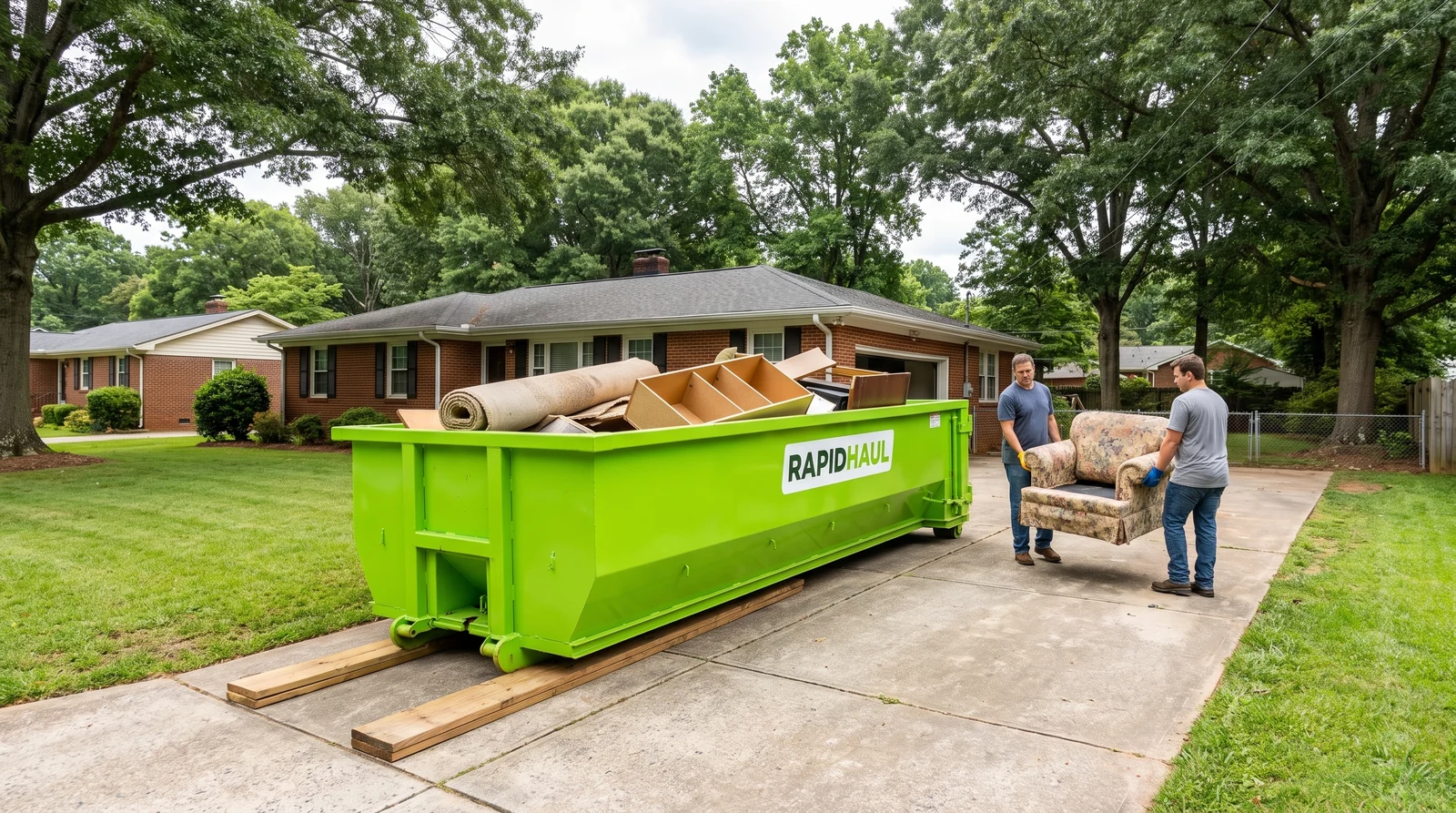
Read that list against a real cleanout and the pattern is obvious. Anything structural, anything heavy and mineral, anything pressurized, and anything a contractor touched has to find another route. That is precisely the pile a driveway container is built for, and it is the reason most whole-house cleanouts end up renting one even when the furniture went to the curb for free.
The items that need their own plan
Four categories deserve a decision before the container arrives, because none of them belong in it. Paint, solvents, pesticides, and pool chemicals go to a county center, free, from a residential vehicle. Propane tanks and oxygen tanks are refused at the curb and need to be declared to the attendant at a county center. Electronics and batteries should never go in a curbside recycling cart because of fire risk; county centers take them. Anything with refrigerant, meaning a refrigerator, freezer, window air conditioner, or wine cooler, is eligible for city pickup as a recyclable item, but it must be empty with the door removed. Our guide to what can and cannot go in a dumpster covers the full prohibited list.
Clearing a family home in Charlotte?
Tell us how many rooms are coming out and we will tell you which size fits, usually with same-day delivery to the driveway.
Sizing a container for a whole house
Estate cleanouts are the one job where families reliably undersize. The furniture looks manageable until the closets, the linen cupboards, the garage shelving, and forty years of boxes go in behind it. Loose household goods also do not compress; a container fills by volume long before it fills by weight, which is why the 20 and 30-yard sizes do most of this work.
A useful mental yardstick: a 20-yard container is roughly the volume of six pickup truck loads, and a 30-yard is roughly nine. Count the truckloads you think the house holds, then add a third, because everyone underestimates. Our head-to-head size comparison and the full sizing guide go deeper if you are between two sizes.
| Size | Price | Weight included | Right for |
|---|---|---|---|
| 15-yard | $400 | 1.5 tons | A one-bedroom apartment or condo, or a garage and basement only |
| 20-yard | $450 | 2 tons | A two-bedroom home, or a three-bedroom after a heavy donation pass |
| 30-yard | $545 | 3 tons | The default for a full three-bedroom house with a garage |
| 40-yard | $695 | 4 tons | Four bedrooms and up, decades of storage, or a full attic and basement |
Driveway placement and the seven-day window
Two logistics questions come up on every estate cleanout call. First, placement: a container on your own driveway or private property in Charlotte does not require a permit. A permit only enters the picture when the container has to sit on a public street, which our Charlotte permit guide covers in detail. Second, the calendar: the included window is seven days, and extra days are $25 each. For a house being cleared over two consecutive weekends, that is five extra days, or $125, and it is almost always cheaper than a second delivery.
What an estate cleanout costs in Charlotte
Families ask for one number, and the honest answer is that a cleanout is four numbers stacked: the court filing, the disposal, the labor, and the optional specialists. Only the first two are fixed. The chart below builds a realistic middle case for a three-bedroom Charlotte house cleared by family members over two weekends, with a good donation pass and a 30-yard container.
Overage weight is the other number worth understanding before you load. Each size includes a weight allowance, and past it the rate is $100 per ton. Ordinary household contents almost never reach it, because furniture, clothing, and boxes are bulky rather than heavy. What does reach it is demolition material: tile, plaster, old countertops, and the concrete or brick that sometimes comes out of a garage. If the cleanout includes any of that, say so when you book so the size and the weight allowance are matched to the job rather than to the furniture.
What is not in that chart
Three costs sit outside it and deserve naming. Appraisal for jewelry, coins, art, or firearms is worth paying for when you genuinely cannot value something. Carrying costs on the house itself, meaning utilities, insurance, and lawn care, accrue every week the cleanout drags; a house held two extra months is a real number. And overage weight, at $100 per ton past the included allowance, is the line families trip on when a cleanout turns into a demolition and the container fills with tile, plaster, or old countertops.
How long a whole house really takes
Set expectations honestly with everyone who is helping, because an estate cleanout that was sold to the family as “a weekend” and turns into six weeks does more damage to relationships than the work itself does to backs.
For a three-bedroom house with thirty years of accumulation and a crew of two to four family members working weekends, the realistic calendar is two to three weeks end to end, of which perhaps four to six actual working days are spent in the house. Phase 1 mostly runs in parallel as waiting time. Phase 2 is one long day. Phase 3 is the bulk of it. Phase 4 needs lead time, because donation pickups are scheduled days out, not hours out. Phase 5 compresses into the seven-day container window, which is why the container should arrive after the sorting is largely done rather than on day one.
A four-bedroom house with a full basement and a working garage is a different animal. Plan on four to six weeks, expect to want a 40-yard container or a swap-out, and consider bringing in help for the heavy furniture even if the family is doing the sorting. Our comparison of junk removal against dumpster rental in Charlotte lays out when hired labor genuinely earns its price, and it is a fair question for anyone clearing a house from out of state.
If the house is going on the market
Work backward from the listing date, not forward from today. A real estate agent will typically want the house empty, cleaned, and any repairs done before photography. That means the container needs to be gone roughly a week before photos, which means the sorting has to be finished two weeks before that, which means Phase 1 needs to start immediately. Writing those four dates on a calendar is the single most useful hour a family can spend.
Five mistakes that cost families the most
Every one of these shows up in cleanouts often enough to be predictable, and every one is avoidable with a decision made a week earlier.
| Mistake | What it actually costs | The fix |
|---|---|---|
| Disposing before the legal authority is settled | Disputes among heirs, and an inventory you can no longer document | File with the clerk first, photograph everything of value |
| Skipping the valuables sweep | Cash, bonds, and jewelry leaving in a donation box | One person, three to six hours, before anything moves |
| Ordering the container on day one | $25 a day for every day spent deciding rather than loading | Sort first, then book for the week you will actually load |
| Undersizing the container | A second delivery, which costs more than the size you skipped | Count truckloads, add a third, and use the cost-per-yard math |
| Assuming charities take everything | A loaded truck, a refused donation, and a reloaded truck | Call first and describe the condition honestly |
One more, and it is not about money
The mistake that costs families the most is starting in the room with the photographs. Nobody sorts efficiently while reading forty years of letters, and nobody should have to. Put the photographs, letters, and albums in labeled boxes on day one without opening them, move them to one person’s house, and go through them in December with a cup of coffee. The cleanout has a deadline. The memories do not.
Frequently asked questions
How much does it cost to have an estate cleaned out?
What is an estate cleanout?
What is the best way to clean out my parents’ home after their death?
How long does an estate cleanout take?
What size dumpster do I need for a whole house cleanout?
Do I need a permit for a dumpster during a Charlotte estate cleanout?
Can I put everything from the house in one dumpster?
The bottom line
Clearing a family home is a project with a legal phase, a search phase, a sorting phase, a giving phase, and a disposal phase, and the families who finish in two weeks instead of two months are simply the ones who ran them in that order. Settle authority at the courthouse on East Fourth Street. Spend a day looking for what is hidden. Sort one room at a time into five piles. Call the charities before you load anything. Then put a container in the driveway for the week you actually intend to work.
Rapid Haul delivers 15, 20, 30, and 40-yard roll-offs across Charlotte and 34 surrounding communities, usually the same day, with seven days of rental, delivery, and pickup included. If you are not sure which size a house needs, tell us how many rooms are coming out and we will tell you. Book online or call 833-DUMP-365 (833-386-7365).
| Quick reference | Contact or detail |
|---|---|
| Open the estate | Clerk of Superior Court, 832 East Fourth St, Charlotte NC 28202, 704-686-0400, 9 a.m. to 5 p.m. weekdays |
| Schedule a Charlotte bulky pickup | 311 or 704-336-7600, the CLT+ app, or the city’s online request |
| County center hours | Monday to Saturday, 7 a.m. to 4 p.m., all four locations |
| Nearest center, east Charlotte | Hickory Grove, 8007 Pence Road |
| Donate furniture and building supplies | Habitat Charlotte Region ReStore, 704-392-4495, free pickup for large items |
| Donate clothing and housewares | Goodwill of the Southern Piedmont, 704-393-6880 |
| Rent a container for the cleanout | Rapid Haul, 833-DUMP-365 (833-386-7365) |