Yard Waste Removal in Charlotte: Fall Cleanup Options, Rules, and Costs
Curbside limits, county drop-off fees, and when a container beats both
Charlotte has four real ways to get rid of yard waste, and which one you need comes down to a single question: will the pile fit the city’s five-foot rule. The City of Charlotte collects yard waste from the curb once a week at no separate charge, but only in paper bags, uncovered containers no larger than 32 gallons, and brush piles built from limbs no longer than five feet and no thicker than four inches. Everything inside those limits is free. Everything outside them is your problem to solve.
That line is where most fall cleanups land in trouble. A weekend of raking fits the curb easily. Taking out a row of overgrown ligustrum, grinding through a storm-dropped oak limb, or clearing a quarter acre of brush produces material the city is not set up to take, and the two options that remain are hauling it yourself to one of Mecklenburg County’s four full-service centers or putting a container in the driveway. This guide walks all four routes with the current rules, the county’s actual fee ladder, the weight math that catches people out, and honest advice about when a roll-off is overkill.
Key Takeaways
- Curbside is weekly and free, collected on your regular garbage day, but only if the material meets the preparation rules.
- Five feet and four inches is the hard limit on brush, limbs, and logs. Tree stumps are never collected.
- Paper bags only. Solid Waste Services mandates paper bags for grass clippings, leaves, and weeds, and plastic bags including compostable plastic are not accepted.
- Set out no earlier than the day before. A minimum $150 citation may be issued for putting yard waste at the curb too soon.
- The county is free up to five bags. Beyond that, $8.00 per unit, or $40.00 per ton with a $16.00 minimum for truck and trailer loads.
- Yard waste is heavier than it looks. Mixed yard debris runs about 250 pounds per cubic yard loose and 640 pounds compacted, so tamping a container down is how you buy an overage.
- A roll-off is the right call for landscaping tear-outs, storm piles, and lot clearing, not for a weekend of raking. Rapid Haul runs $400 for a 15-yard and $450 for a 20-yard with seven days included.
What’s in this guide
- The four ways Charlotte gets rid of yard waste
- What the city takes at the curb, item by item
- The preparation rules that get a pile skipped
- What Charlotte will not collect, and where it actually goes
- Hauling it yourself: four county centers and the fee ladder
- Why a yard waste pile weighs more than it looks
- When a roll-off container is the right tool
- Sizing a container for yard debris
- What each option actually costs
- The Charlotte fall cleanup calendar
- Loading yard debris without blowing the weight limit
- Five mistakes that cost Charlotte homeowners money
- Frequently asked questions
- The bottom line
The four ways Charlotte gets rid of yard waste
Before the rules, the map. Every pile of leaves, limbs, and torn-out shrubbery in Mecklenburg County goes out through one of four doors, and each has a different ceiling on volume, a different cost, and a different amount of your labor baked in.
The first door is the curb. City of Charlotte Solid Waste Services collects yard waste from the curb once a week on your scheduled collection day, at no separate charge beyond the solid waste fee you already pay. It is the cheapest option in Charlotte and it will handle the large majority of ordinary household yard work, provided the material is prepared the way the city asks.
The second door is self-haul. Mecklenburg County runs four full-service disposal and recycling centers that accept yard waste from residents, open Monday through Saturday, 7 a.m. to 4 p.m. Small quantities go in free. Larger ones are charged on a published ladder that most people have never read, which is why it surprises them at the fee booth.
The third door is hiring the work out. A landscaping crew or a hauling service will load and remove the debris for you, priced by volume or by the truckload. It is the least work and the most expensive per cubic yard, and it makes sense when you physically cannot do the loading.
The fourth door is a roll-off container in the driveway. You load it on your own schedule over several days, and the hauler takes the whole thing away. It is the only option with no practical volume ceiling, which is exactly why it exists for the jobs the first three cannot absorb.
| Option | Best for | Volume ceiling | Your labor |
|---|---|---|---|
| City curbside | Routine mowing, raking, light pruning | Bags and piles that meet the prep rules, collected weekly | Bag it and drag it to the curb |
| County self-haul | One truckload you want gone this week | Whatever fits your vehicle, priced by the load | Load, drive, unload, repeat |
| Hire a crew | Anyone who cannot do the lifting | Set by the quote, usually per truckload | None |
| Roll-off container | Landscaping tear-outs, storm piles, lot clearing | 15 to 40 cubic yards per container, with swap-outs available | Load it, on your own schedule |
What the city takes at the curb, item by item
Charlotte’s yard waste program is more generous than most people assume, and the published list of accepted materials is longer than the three things everybody remembers. Yard waste is collected weekly from the curb on your scheduled collection day, and the city sends it to be made into mulch and compost rather than to a landfill, which is not just a nice touch. North Carolina law bans yard trash from ordinary landfill disposal under G.S. 130A-309.10, so composting is the legal route for the material as well as the sensible one.
What goes out at the curb is material generated maintaining your own residential yard and garden. The city’s accepted list runs to grass clippings, leaves, limbs, logs, mulch, plants, prunings, shrubbery, tree trimmings, and weeds, plus live Christmas trees in season. Two entries on that list carry an asterisk worth noticing: mulch and shrubbery are accepted with no roots or dirt attached. Dirt is a different material with a different destination, and a root ball caked in Carolina red clay is not shrubbery as far as the truck is concerned.
Live Christmas trees are collected at single-family homes after the holidays, but only once they are stripped. Lights, ornaments, and tinsel all have to come off, and a decorated tree gets left at the curb. Artificial trees are a separate matter entirely and go through bulky item collection rather than yard waste.
| Accepted for curbside yard waste | Condition or limit |
|---|---|
| Grass clippings, leaves, weeds | Paper bags required, or uncovered containers no larger than 32 gallons |
| Brush and limbs | No longer than 5 feet, no larger than 4 inches in diameter, not tied |
| Logs | Must be under 4 inches in diameter |
| Plants, prunings, tree trimmings | Generated in the maintenance of a residential yard or garden |
| Shrubbery and mulch | Accepted with no roots or dirt attached |
| Live Christmas trees | Single-family homes, free of all lights, ornaments, and tinsel |
The preparation rules that get a pile skipped
A skipped pile is almost never a judgment call by the driver. It is a preparation rule, and there are only a handful of them. Knowing all of them takes about a minute and saves a week of the pile sitting there looking at you.
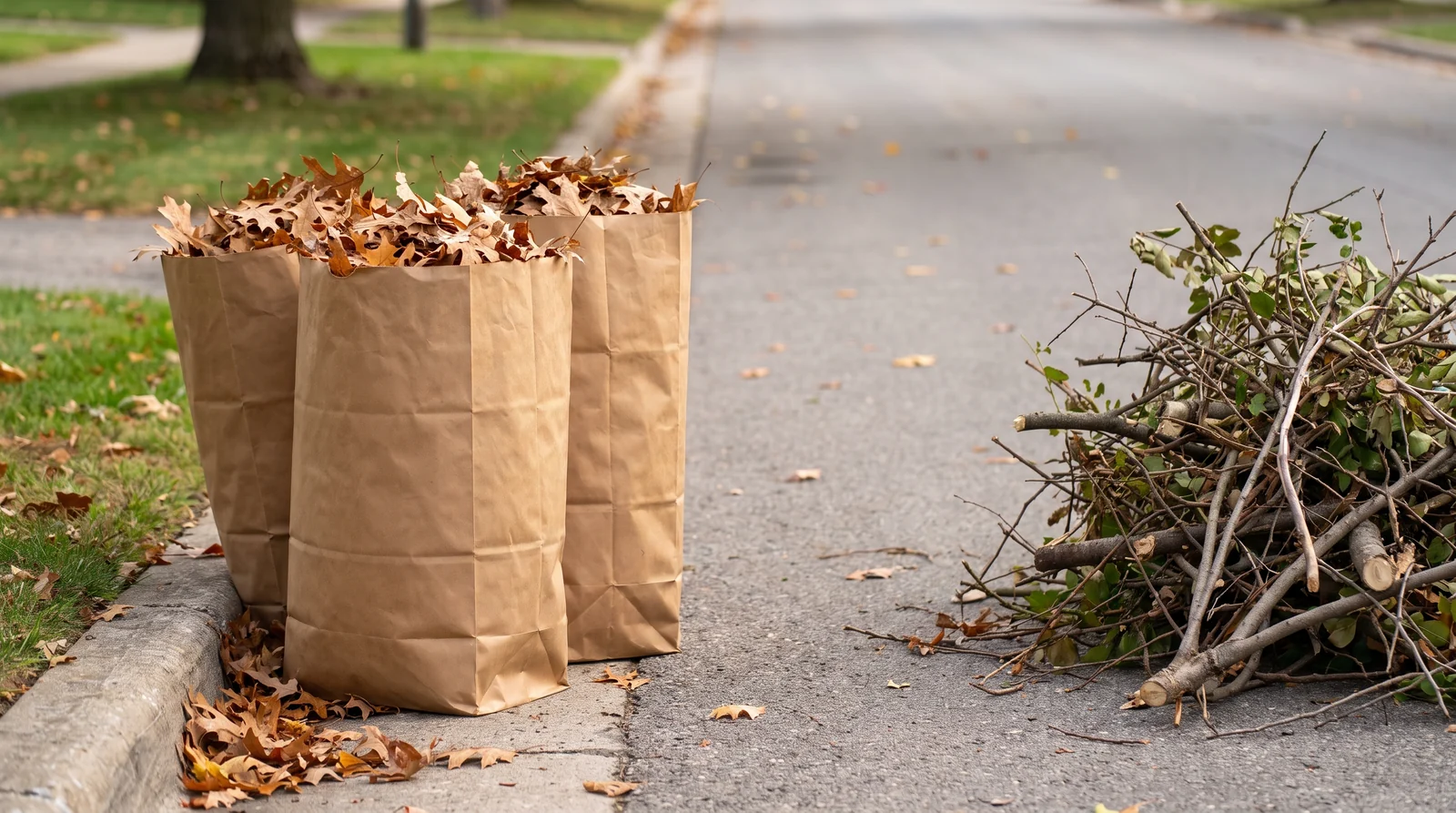
Start with the container. The city’s published yard waste guidelines mandate the use of paper bags for grass clippings, leaves, and weeds. Plastic bags are not accepted, and the rule explicitly covers compostable plastic bags as well, which is the part that catches people who bought them believing they were the responsible choice. If you prefer a reusable container, it has to be uncovered and no larger than 32 gallons. Whichever you choose, no single container or bag may weigh more than 75 pounds, which is a real limit once leaves get rained on.
Then the geometry. Brush and limbs go into separate piles no longer than five feet and no higher than three feet, with two feet of clear space between piles. Limbs should not be tied, which catches out everyone who has ever lived somewhere that required bundling. The truck has a grapple, and loose material is faster for it than a bound bundle.
Placement has its own rules. Yard waste goes within six feet of the curb and at least three feet away from other collection items and from obstacles like mailboxes, utility poles, and parked cars, without blocking the sidewalk. It needs to be out by 6 a.m. on your collection day, and no sooner than the day before. That last rule has teeth: a minimum $150 citation may be issued for setting yard waste out too early, which is a steep price for getting ahead of yourself on a Wednesday.
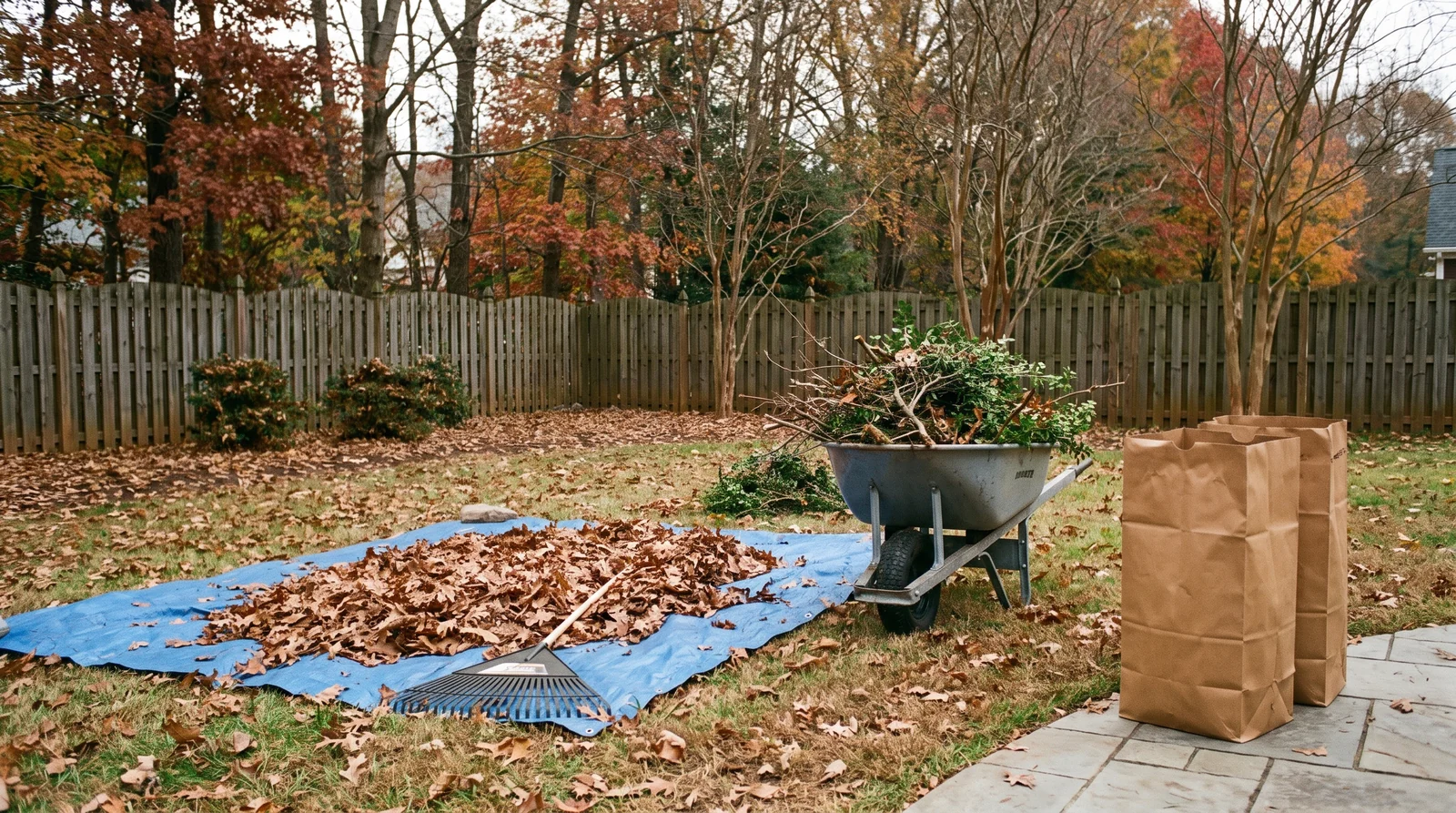
Two rules exist purely because of how the truck works. No loose debris is collected from wheelbarrows, and wheelbarrows will not be dumped. Likewise, no debris is collected from tarps. If you rake onto a tarp, which is the fastest way to move leaves, the tarp is a transport device, not a container. Empty it into paper bags at the curb.
What Charlotte will not collect, and where it actually goes
The exclusions matter more in October than in any other month, because fall is when Charlotte homeowners stop maintaining and start removing. A pruning job produces curbside material. A removal job usually does not.
Tree stumps are the clearest line. The city will not collect them, full stop, and there is no size at which that changes. Logs have to be under four inches in diameter, which means the trunk sections from any tree worth calling a tree are out of scope. A stump and the trunk rounds beside it need a different plan on day one, not after the truck has passed twice.
Dirt and rocks are not yard waste. Neither is a root ball with soil still on it, which is why the city’s accepted list specifies shrubbery and mulch with no roots or dirt. If you are pulling out a hedge, knock the soil off the roots where you reasonably can, and understand that the heavy, dirt-laden remainder is a separate disposal question.
Then there is the category that catches people after they have hired someone. Charlotte’s bulky item collection, the companion program that takes furniture and appliances, explicitly excludes yard waste and plant materials, tree stumps, dirt, rocks, bricks, concrete, and railroad ties. It also excludes any materials resulting from work performed by a commercial contractor. So if a tree service drops a sycamore and leaves the debris, or a landscaper tears out your foundation plantings and departs, that pile is not going out through either city program. Before you hire anyone for fall work, settle in writing whether debris removal is included in the price. It is the single most common surprise cost in a Charlotte yard project.
| Not collected at the curb | Where it actually has to go |
|---|---|
| Tree stumps | County center or a roll-off container, depending on size |
| Logs and trunk sections over 4 inches in diameter | County centers accept whole trees up to a posted diameter, or a container |
| Root balls with soil attached | County accepts root balls smaller than a basketball; larger ones need a container |
| Dirt, rocks, bricks, concrete | Not yard waste at all; these are heavy debris with their own handling |
| Debris from a commercial contractor | The contractor’s responsibility, or yours in a container |
| Anything on a tarp or in a wheelbarrow | Transfer it into paper bags or a proper container first |
Hauling it yourself: four county centers and the fee ladder
When a pile outgrows the curb but is not big enough to justify a container, the county is the middle gear. Mecklenburg County operates four full-service disposal and recycling centers that take yard waste from residents, all open Monday through Saturday from 7 a.m. to 4 p.m. County residents get a blue entry sticker free with a driver’s license as proof of residency, and non-residents can buy an annual sticker.
The four locations are Compost Central at 140 Valleydale Road in west Charlotte, Foxhole at 17131 Lancaster Highway in the far south, Hickory Grove at 8007 Pence Road on the east side, and North Mecklenburg at 12300 N. Statesville Road in Huntersville. For most of the city, one of them is a twenty-minute drive, and the practical difference between them is what size tree they will take. Hickory Grove and North Mecklenburg accept trees up to 24 inches in diameter. Compost Central and Foxhole go up to 48 inches, which makes them the right destination when a real tree has come down.
The acceptance list is broader than the city’s. The county takes leaves, brush, and grass clippings, limbs under five feet, bamboo under five feet, clean unpainted and untreated pallets under five feet, and small root balls smaller than a basketball. Plastic bags still are not accepted, so if you have bagged in plastic you will be emptying them at the tipping face. And the material comes back around: the county makes mulch from the brush it receives and offers it back to customers at its recycling centers, so a trip out with a truckload of limbs can be a trip back with mulch for the beds.
The fees are where people get caught, and the county publishes the whole ladder. Up to five 32-gallon bags, or six kraft paper bags, costs nothing. More than five bags, in a load piled no higher than two feet, is $8.00 per unit. And once you arrive with a vehicle with built-up sides, a load over three cubic yards, logs over four inches in diameter, or a trailer longer than eight feet, you are into the tonnage rate: $40.00 per ton with a $16.00 minimum. Worth knowing before you borrow a trailer, and worth calling 311 or 980-314-3867 first, because the county has posted temporary load restrictions at individual centers in the past.
| What you arrive with | County yard waste fee | In practice |
|---|---|---|
| Up to five 32-gallon bags, or six kraft paper bags | No charge | A car trunk or back seat of leaves |
| More than five bags, load piled no higher than 2 feet | $8.00 per unit | A pickup bed loaded level |
| Built-up sides, over 3 cubic yards, logs over 4 inches, or a trailer over 8 feet | $40.00 per ton, $16.00 minimum | A heaped truck, a dump trailer, a real tree job |
Why a yard waste pile weighs more than it looks
Yard debris is the material people misjudge most badly, and they misjudge it in both directions. Loose brush feels heavy to carry and is actually light by volume. Leaves feel weightless and are among the heaviest yard materials per cubic yard once they are damp and packed. Both mistakes cost money, one at the county scale and one on a container invoice.
The US Environmental Protection Agency publishes standard volume-to-weight conversion factors used across the waste industry, and the yard trimmings entries tell the whole story. Loose branches, prunings, and trimmings come in at 127 pounds per cubic yard. Mixed yard waste, uncompacted, runs 250 pounds per cubic yard. Leaves are listed at 250 to 500 pounds per cubic yard, a range that mostly reflects how wet they are. And mixed yard waste, compacted, jumps to 640 pounds per cubic yard, which is more than five times the weight of the same volume of loose brush.
Those numbers matter at two different moments. At a county fee booth, weight is the billing unit once your load crosses into the tonnage band, so a damp leaf load and a dry brush load of identical size produce different invoices. In a rented container, weight is the line between a flat price and an overage. In both cases the material has not changed and your eye has no way to tell the difference, which is why the published conversion factors are worth more than intuition here. Applied to the volumes a Charlotte yard job actually moves, they land like this.
| What you are carrying | Volume | Estimated weight | What that means |
|---|---|---|---|
| One 32-gallon container of leaves | 0.16 cubic yards | 40 to 79 lbs | Dry leaves are easy, soaked leaves hit the city’s 75 lb ceiling |
| Pickup bed loaded level, mixed debris | About 2 cubic yards | About 500 lbs | Comfortably under the county’s $16.00 tonnage minimum |
| 15-yard container of pure brush | 15 cubic yards | About 1,900 lbs | Well inside the 1.5 tons included in the rental |
| 30-yard container of mixed yard waste | 30 cubic yards | About 7,500 lbs | Roughly three quarters of a ton over the 3 tons included |
Run that first row backwards and the city’s rules stop looking arbitrary. A 32-gallon container is about 0.16 cubic yards. Filled with dry leaves at 250 pounds per cubic yard it weighs roughly 40 pounds, which anyone can carry. Filled with the same leaves after a Carolina rain, at 500 pounds per cubic yard, it weighs close to 79 pounds, which is past the city’s 75-pound limit on any single bag or container. The weight rule is not a guess about how strong you are. It is the point at which a wet 32-gallon container becomes a two-person lift for a crew doing it six hundred times a day, which is why it exists and why it is worth respecting. Rake before the rain where you can, and if you cannot, fill the bags two thirds rather than to the brim.
That last figure is the one worth memorizing. Compaction does not change what you are throwing away, it changes what the scale says. Jumping into a container to stomp the material down, which feels like good sense because it buys space, roughly doubles or triples the weight of every cubic yard you have loaded. On a disposal method priced by weight, that is a self-inflicted cost.
When a roll-off container is the right tool
Here is the honest version, because it matters more than the sales version: for a weekend of raking, a roll-off is the wrong answer. The city takes that material weekly at no extra charge, and paying for a container to hold six bags of leaves is spending money to solve a problem you do not have.
A container earns its keep when the volume, the timing, or the material puts the first three options out of reach. Four fall jobs reliably clear that bar in Charlotte. The first is a landscaping tear-out: ripping out mature foundation shrubs, an overgrown hedge, or a bed of ornamental grasses produces root balls, soil, and woody material in a single afternoon, and the city’s five-foot, four-inch, no-roots-or-dirt rules exclude most of it.
The second is storm debris. A wind event that drops limbs across a yard creates more volume in an hour than curbside collection will clear in a month of weekly passes, and large trunk sections are outside the program entirely. The third is lot clearing, where you are not maintaining a yard at all but converting brush and saplings into usable ground. The fourth is the mixed project, where yard debris is one component of a job that also produces fence boards, old deck lumber, a rotted shed, or a torn-out patio. Mixed loads are a roll-off’s natural habitat, and they are exactly what the city’s programs are not built for.
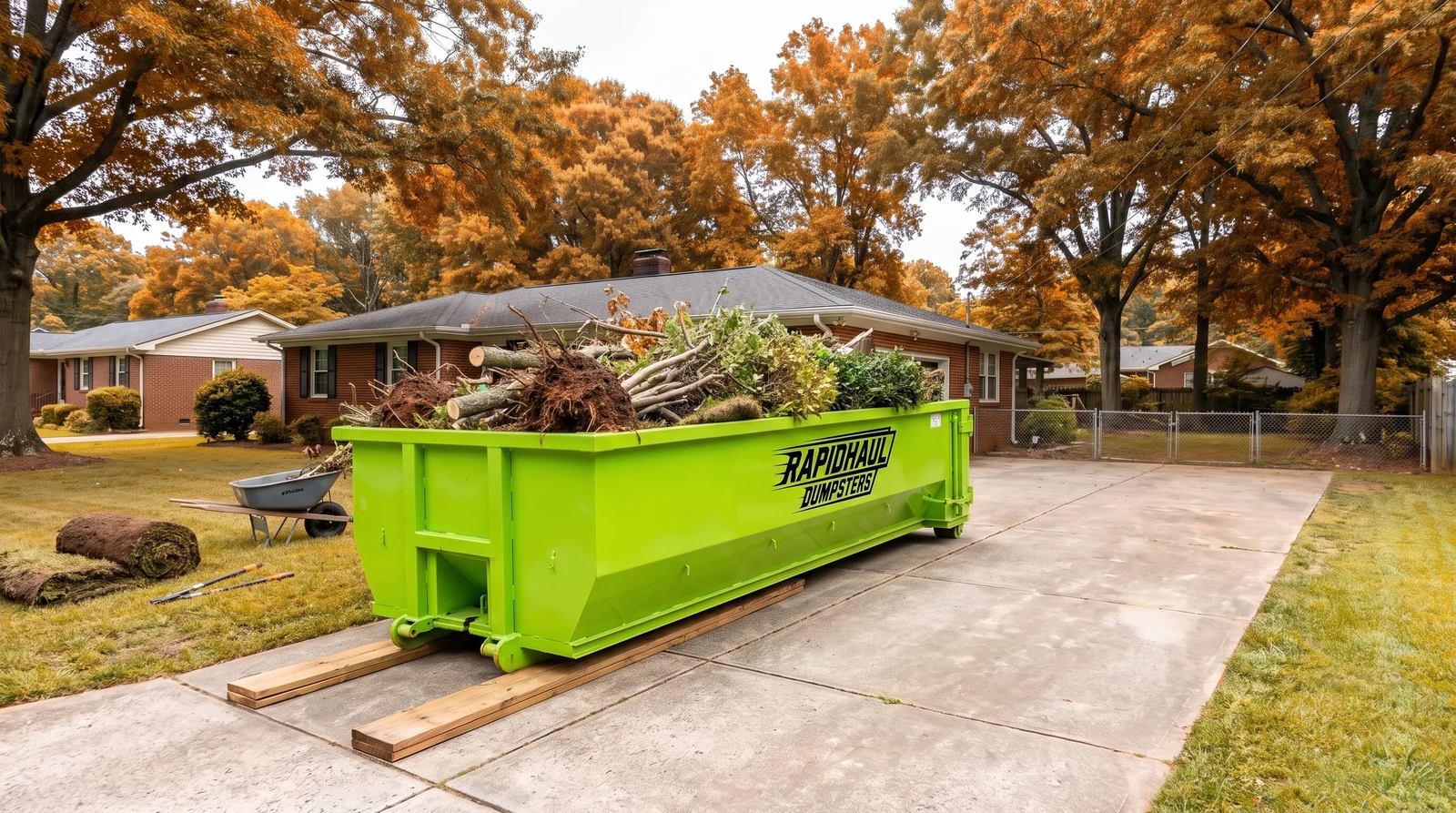
Rapid Haul accepts yard waste in all four container sizes: branches, limbs, and brush cut to fit, grass clippings, leaves, shrub trimmings, garden debris, dead plants, and clean sod. Clean dirt without contamination is generally accepted too, though weight becomes the governing concern rather than volume. The practical advantage over every other route is the clock. The container sits in the driveway for seven days, so you work Saturday, think it over Sunday, find three more things on Wednesday, and it is all still handled.
Sizing a container for yard debris
Yard debris sizes differently from household junk, and the reason is the weight table above. A container of furniture and boxes fills up long before it gets heavy. A container of yard waste can do either, depending entirely on what is in it, so the right size depends on which material dominates.
For brush-dominant loads, size on volume alone. At 127 pounds per cubic yard, a 15-yard container filled to the rails with branches and prunings weighs roughly 1,900 pounds, well inside the 1.5 tons included. Even a 40-yard of pure brush comes in near 5,100 pounds against an 8,000 pound allowance. Brush will run out of room long before it runs out of weight, which means you should pick the size that matches the pile and stop worrying about the scale.
For mixed yard waste, the math flips. At 250 pounds per cubic yard, a container filled to the brim with mixed debris lands about 25 percent above its included weight at every size. A 15-yard works out near 3,750 pounds against 3,000 included. A 30-yard lands near 7,500 pounds against 6,000. That is not a disaster, it is just a number to know: overage runs $100 per ton, so a 30-yard filled to the rails with mixed yard waste is carrying roughly three quarters of a ton of overage. Either fill to about four fifths and stop, or budget the difference deliberately.
The practical rule for Charlotte fall projects: a 15-yard handles a single large bed tear-out or a heavy pruning job on a standard quarter-acre lot. A 20-yard is the workhorse for a whole-yard cleanup with shrub removal. A 30-yard is for storm damage, lot clearing, or a landscape renovation that includes hardscape. The size guide walks through the estimate in more detail, and the head-to-head size comparison is the faster read if you are down to two.
What each option actually costs
Cost comparisons in this category are usually rigged, because they compare a price you pay to a price somebody else pays and leave your own labor out. The honest comparison puts a cost per cubic yard next to the number of hours and trips each route demands, and lets you decide what your Saturday is worth.
Curbside is free at the point of use for households already receiving city collection, and it is unbeatable on cost for anything that fits the rules. The only expense is the paper bags themselves and the labor of bagging.
Self-haul is the cheapest per cubic yard once you exceed the curbside limits, and it is not close. At $40.00 per ton and roughly 250 pounds per cubic yard for mixed yard waste, the county’s tipping fee works out to about $5 per cubic yard, subject to the $16.00 minimum. What it costs you instead is trips. A full-size pickup bed is roughly 6.5 feet by 5 feet by 20 inches deep, which is about two cubic yards loaded level. Twenty cubic yards of debris is therefore ten round trips to Valleydale Road or Pence Road, each one loaded by hand at your end and unloaded by hand at theirs, inside a Monday-to-Saturday window that closes at 4 p.m.
A roll-off converts those ten trips into one phone call. Rapid Haul runs $400 for a 15-yard, $450 for a 20-yard, $545 for a 30-yard, and $695 for a 40-yard, each with seven days of rental, delivery, and pickup included, extra days at $25 and overage at $100 per ton. On a per-cubic-yard basis that is $26.67 at 15 yards and $18.17 at 30 yards. More than the county, less than hiring the work out, and the only one of the four options where the material leaves your property without you driving anywhere. Our full Charlotte rental cost guide breaks down what is included at every size.
Hiring a crew is priced by volume or by the truckload and varies widely by the job. If you go that route, ask for the quote as a price per cubic yard rather than per load, since that is the only form in which it can be compared against anything else on this page. The economics of paid labor versus a self-loaded container are worked through in detail in our comparison of junk removal and dumpster rental in Charlotte.
| Route | What you pay | Roughly per cubic yard | What it costs you in time |
|---|---|---|---|
| City curbside | No separate charge, plus paper bags | Effectively $0 | Bagging, and waiting for your weekly collection day |
| County self-haul | Free to 5 bags, then $8.00 per unit or $40.00 per ton | About $5 at the tonnage rate | Two cubic yards per pickup load, round trip each time |
| 15-yard roll-off | $400, 7 days, 1.5 tons included | $26.67 | Loading only, spread across a week |
| 20-yard roll-off | $450, 7 days, 2 tons included | $22.50 | Loading only, spread across a week |
| 30-yard roll-off | $545, 7 days, 3 tons included | $18.17 | Loading only, spread across a week |
| Hired crew | Quoted per load or per volume | Ask for it stated this way | None, which is what you are paying for |
The Charlotte fall cleanup calendar
Charlotte’s leaf drop is long and late, and the reason is botanical rather than meteorological. Oaks are among the trees that hang onto dead foliage through the cold months, a habit called marcescence, and on oaks those brown leaves may remain attached until spring bud growth pushes them free. Under a mature oak, a single October cleanup never finishes the job the way it does further north. Charlotte is also adding canopy on purpose: the city’s published tree canopy goal is 50 percent coverage by 2050. The upside is shade and property value. The downside is that every homeowner under those trees is running a multi-month leaf operation rather than a single weekend.
Plan the season in three waves rather than one push. The October wave is structural: cut back perennials, pull spent annuals, prune what needs pruning before dormancy, and tear out whatever is being removed this year. This is the wave that produces woody material and root balls, and it is the only wave where a container usually makes sense.
The November and December wave is volume without weight. It is leaves, week after week, and it belongs at the curb in paper bags, because curbside collection runs weekly all year and the material is exactly what the program was built for. The January wave is the cleanup’s tail: live Christmas trees, stripped of decorations, and any storm damage the winter has handed you.
Two timing notes save real money. First, if you are hiring tree work, settle debris removal in the contract before the saw starts, since the city will not collect debris resulting from work performed by a commercial contractor through bulky collection. Second, if you are renting a container for the structural wave, schedule it for the week you will actually work rather than the week you intend to start. Seven days is generous when you are loading and short when you are still deciding.
Loading yard debris without blowing the weight limit
If you have decided on a container, the loading approach is worth two minutes of planning, because yard debris is the one material where how you load it changes what you pay.
Load long material first and lay it flat. Limbs and trunk sections stacked lengthwise along the floor of the container use the space efficiently and keep the load stable. Standing branches on end wastes a third of the volume and makes the whole load spring back above the rails, which is a problem because the container has to be covered and legal to transport.
Shake the dirt off root balls at the hole, not in the container. Soil is the single densest thing that ends up in a yard waste load, and a root ball that keeps its clay is adding weight you have no use for. The same logic applies to sod: clean sod is accepted, but sod carries its own soil layer, so it is worth knowing that a few rolls will register on the scale far more than their volume suggests.
Fill gaps with the light stuff. Loose brush, leaves, and clippings should go in last, packed around the woody material rather than layered beneath it. That is the opposite of how most people load, and it is the reason a container that looks full often is not.
And resist the urge to compact. Leaves and clippings at 250 pounds per cubic yard become 640 pounds per cubic yard once they are packed down, which converts a comfortable load into an overage. If you genuinely need more volume, the right answer is the next size up or a swap-out, not stomping. Our guide to what can and cannot go in a dumpster covers the rest of the loading rules, including the materials that have to stay out of the container entirely.
| Do this | Not this | Why it matters |
|---|---|---|
| Lay limbs and logs flat along the floor first | Standing branches upright | Recovers up to a third of the usable volume |
| Knock soil off root balls at the hole | Loading clay-packed root balls whole | Soil is the densest thing in a yard load |
| Pack leaves and clippings into the gaps last | Layering light material on the bottom | Fills dead space without adding height |
| Keep the load level with the top rail | Heaping above the rails | An overfilled container cannot be legally hauled |
| Order the next size up if you run short | Climbing in to stomp it down | Compaction raises weight from 250 to 640 lbs per cubic yard |
Yard project bigger than the curb?
Rapid Haul delivers 15, 20, 30, and 40-yard roll-offs across Charlotte and 34 surrounding communities, usually the same day, with seven days of rental included. Tell us what you are tearing out and we will tell you the size.
Five mistakes that cost Charlotte homeowners money
The first is setting out early. Putting yard waste at the curb more than one day ahead of collection risks a minimum $150 citation, and it happens most often when someone finishes a Saturday project and puts the pile out for a Tuesday pickup. Keep it on the property until Monday.
The second is plastic bags. Plastic is not accepted, and the rule names compostable plastic bags specifically, which is the detail that catches people who bought them on purpose. The whole program feeds a composting operation, and plastic has to be removed by hand upstream of it. Buy the kraft paper bags.
The third is assuming the tree guy handles it. Debris from work performed by a commercial contractor is not eligible for city bulky collection, and the stumps and large trunk rounds a tree job leaves behind are outside the yard waste rules as well. That debris is either in the contract or it is your project. Find out which before the crew arrives, not after the truck pulls away.
The fourth is undersizing a container because the pile looks small. Brush is deceptive: a hedge that occupies six feet of bed turns into a startling volume of loose material once it is cut and nothing is nested anymore. Count the pickup loads you think the pile represents, then add half again. The cost difference between a 15 and a 20-yard is $50, and the cost of a second container is not.
The fifth is paying for a container you did not need. If the material fits the five-foot, four-inch rules and you are willing to bag it, the curb is free and it comes every week. We would rather tell you that and earn the call when you actually have a job for us. The permit and placement guide covers the other half of that call, which is where the container can legally sit once you do need one.
| The mistake | What it costs | The fix |
|---|---|---|
| Setting out more than a day early | A minimum $150 citation | Keep the pile on the property until the day before collection |
| Using plastic or compostable plastic bags | A skipped pile and another week of waiting | Kraft paper bags, or uncovered containers up to 32 gallons |
| Assuming the tree crew takes the debris | A full disposal job you did not budget for | Put debris removal in the contract before work starts |
| Undersizing the container | A second rental instead of a $50 step up | Count the pickup loads, then add half again |
| Renting for a job the curb would handle | A few hundred dollars for a free service | If it fits the 5-foot and 4-inch rules, bag it and wait a week |
Frequently asked questions
What is the best way to get rid of yard waste in Charlotte?
Does Charlotte pick up yard waste every week?
Can I throw yard waste in my garbage can?
Can you throw tree limbs in a dumpster?
How do I get rid of branches for free in Charlotte?
Does Charlotte collect tree stumps or large logs?
Will the city take debris left by my landscaper or tree service?
What size dumpster do I need for yard waste?
The bottom line
Yard waste in Charlotte is a sorting problem before it is a disposal problem. Decide which of the four routes each part of the pile belongs to, and the rest is logistics. Leaves and clippings in paper bags, brush cut to five feet, and everything within the preparation rules goes to the curb every week at no separate charge. One truckload above that goes to a county center for a published fee. A tear-out, a storm pile, or a tree job that leaves stumps and trunk rounds goes in a container, because that is the only route with the headroom.
Rapid Haul delivers 15, 20, 30, and 40-yard roll-offs across Charlotte and 34 surrounding communities, usually the same day, with seven days of rental, delivery, and pickup included. Tell us what is coming out of the yard and we will tell you the size, and if the honest answer is that the curb will handle it, we will tell you that too. Book online or call 833-DUMP-365 (833-386-7365).
| Quick reference | Contact or detail |
|---|---|
| Curbside yard waste questions | CharMeck 311, 704-336-7600, or the CLT+ app |
| Curbside limits | Brush and limbs 5 feet by 4 inches, bags and containers 32 gallons and 75 lbs, paper only |
| County centers, all four | Monday to Saturday, 7 a.m. to 4 p.m., 980-314-3867 |
| West Charlotte, biggest trees | Compost Central, 140 Valleydale Road, Charlotte NC 28214 |
| East Charlotte | Hickory Grove, 8007 Pence Road, Charlotte NC 28215 |
| South Charlotte | Foxhole, 17131 Lancaster Highway, Charlotte NC 28277 |
| North Mecklenburg | 12300 N. Statesville Road, Huntersville NC 28078 |
| Rent a container for a yard project | Rapid Haul, 833-DUMP-365 (833-386-7365) |