15 vs 20 vs 30-Yard Dumpster: Which Size Do You Actually Need?
A Charlotte sizing guide with dimensions, capacity math, and per-project picks
For most Charlotte homeowners the choice comes down to this: a 15-yard dumpster ($400) handles a single-room remodel or a focused cleanout, a 20-yard ($450) is the do-everything residential size for garages, roofs, and whole-house projects, and a 30-yard ($545) is for full gut renovations and new-construction debris. The difference is six feet of length and, on the 30, two extra feet of height.
Pick too small and you pay for a second haul or an overage fee. Pick too big and you rent air. This guide puts the three most-rented roll-off sizes side by side, with real dimensions, capacity in pickup-truck loads, the weight each one includes, and a project-by-project pick using Rapid Haul’s published Charlotte pricing. We also fold in the two questions that decide it: how much debris you actually have, and how heavy it is.
Key Takeaways
- 15-yard (14 ft long, $400): one-room remodels, focused garage or basement cleanouts, small deck tear-offs. Holds about 6 pickup loads.
- 20-yard (20 ft long, $450): the most popular residential size. Roof tear-offs, whole-house cleanouts, large landscaping. Holds about 8 pickup loads.
- 30-yard (20 ft long, 6 ft tall, $545): home additions, multi-room gut renos, and contractor debris. Holds about 12 pickup loads.
- The deciding factors are volume and weight. Above roughly three pickup loads, size up. For concrete, dirt, or shingles, the weight limit fills before the box does.
What’s in this guide
- The quick answer: 15 vs 20 vs 30 at a glance
- Roll-off dumpster sizes explained
- 15 vs 20-yard dumpster: which should you pick?
- 20 vs 30-yard dumpster: when to size up
- What size dumpster for your project?
- Don’t forget weight: heavy debris changes the math
- Common dumpster sizing mistakes
- Frequently asked questions
The quick answer: 15 vs 20 vs 30 at a glance
A 15-yard dumpster holds about six pickup-truck loads of debris, a 20-yard holds about eight, and a 30-yard holds about twelve. All three are the same 7.5 feet wide, so they fit a standard Charlotte driveway. What changes is length (the 15 is 14 feet; the 20 and 30 are both 20 feet) and, on the 30, height (six feet instead of four). Here is the full lineup, including the 40-yard for the biggest jobs.
| Size | Dimensions (L×W×H) | Pickup loads* | Weight included | Charlotte price |
|---|---|---|---|---|
| 15-yard | 14 × 7.5 × 4 ft | ~6 | 1.5 tons (3,000 lb) | $400 |
| 20-yard | 20 × 7.5 × 4 ft | ~8 | 2 tons (4,000 lb) | $450 |
| 30-yard | 20 × 7.5 × 6 ft | ~12 | 3 tons (6,000 lb) | $545 |
| 40-yard | 20 × 7.5 × 8 ft | ~16 | 4 tons (8,000 lb) | $695 |
If you only remember one row, make it the 20-yard. It is the size most Charlotte homeowners reach for because it covers the widest range of projects without overpaying, which we break down below. Already know roughly how much debris you have? Jump to the project-by-project picks. If you would rather start from the job itself, our companion guide on what size dumpster you need for common Charlotte projects walks through the cubic-yard estimates room by room.
Roll-off dumpster sizes explained
The “yard” in a dumpster size is cubic yards of volume, not length. A 20-yard dumpster holds 20 cubic yards of debris, which is roughly eight loads from a full-size pickup truck. Industry sizing references put a standard pickup bed at about 2.5 cubic yards when loaded level full (Soil Building Systems), so dividing the dumpster’s cubic yards by 2.5 gives you the pickup-load math in the table above.
Here is what each cubic-yard rating translates to in practice. A cubic yard is a cube three feet on every side, about the size of a standard washing machine. Picture the 15-yard as roughly six of those pickup loads, the 20-yard as eight, and the 30-yard as twelve, and you can eyeball your own pile against it before you ever call.
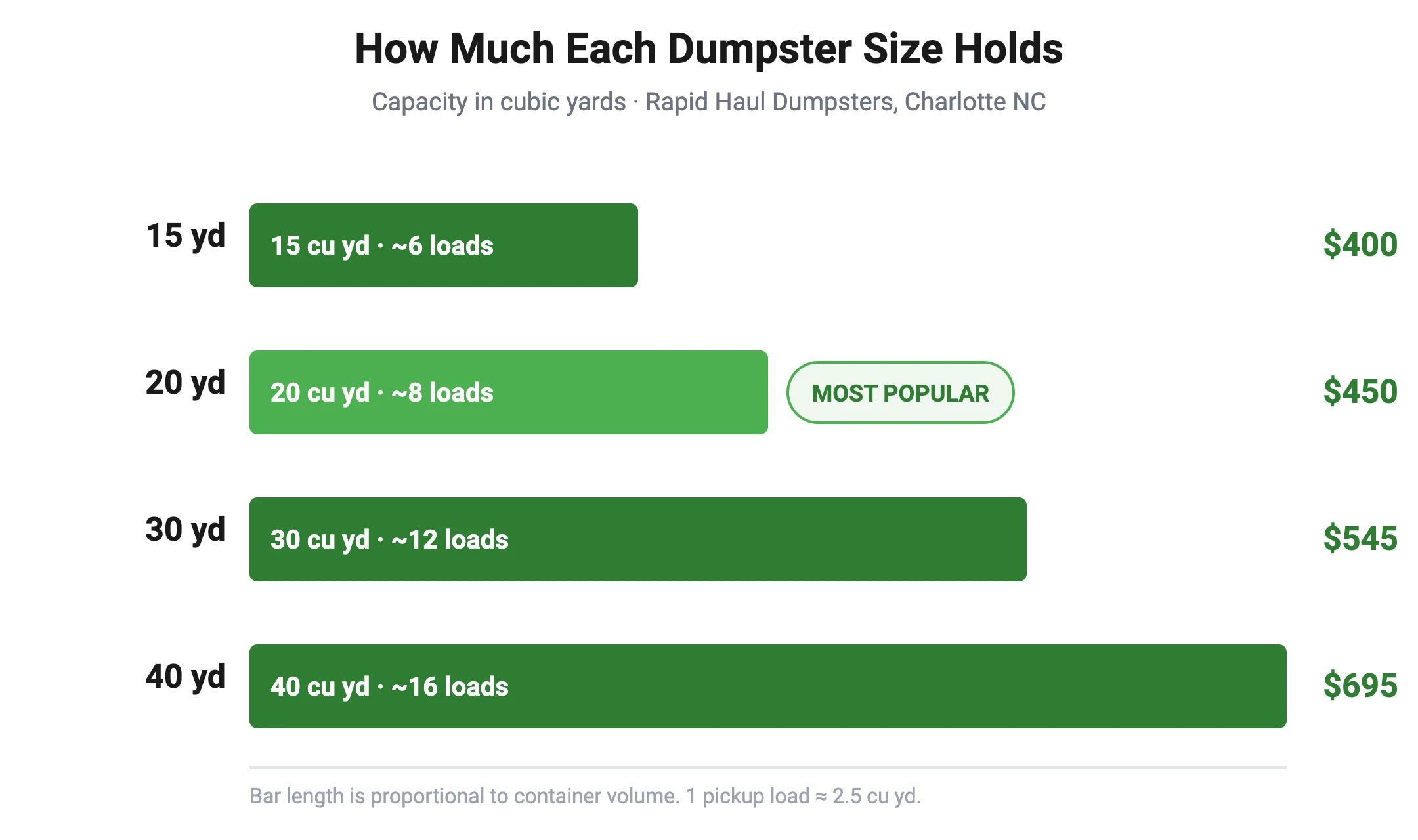
Notice that the footprint barely changes between sizes. The 15-yard is six feet shorter than the others, but the 20, 30, and 40-yard are all 20 feet long and 7.5 feet wide. The 30 and 40 gain their extra capacity by going up, not out: the 30-yard stands six feet tall and the 40-yard a full eight. That matters for two reasons. First, all four fit the same driveway space, so you are not choosing based on where it will sit. Second, taller walls mean you are lifting debris higher to load it, which is worth knowing before you commit to a 40 for a job a 20 could handle. For the full rundown of every size and what stays out of the container, see our guide to what can and can’t go in a dumpster.
15 vs 20-yard dumpster: which should you pick?
Choose the 15-yard for a single, contained project; choose the 20-yard the moment a job touches more than one room or includes a roof. The 20-yard costs only $50 more than the 15 ($450 versus $400) but adds five cubic yards of capacity and another half-ton of weight allowance, so the “is it worth $50” question almost always lands on yes once you have any doubt about volume.
The 15-yard is the right call when the scope is genuinely small and well-defined. A single-bathroom remodel, for example, generates only about 1.5 cubic yards of debris when taken down to the studs, so even our smallest container is more than enough. A focused garage or basement cleanout, a small deck tear-off, or hauling out flooring from a room or two all fit comfortably in a 15.
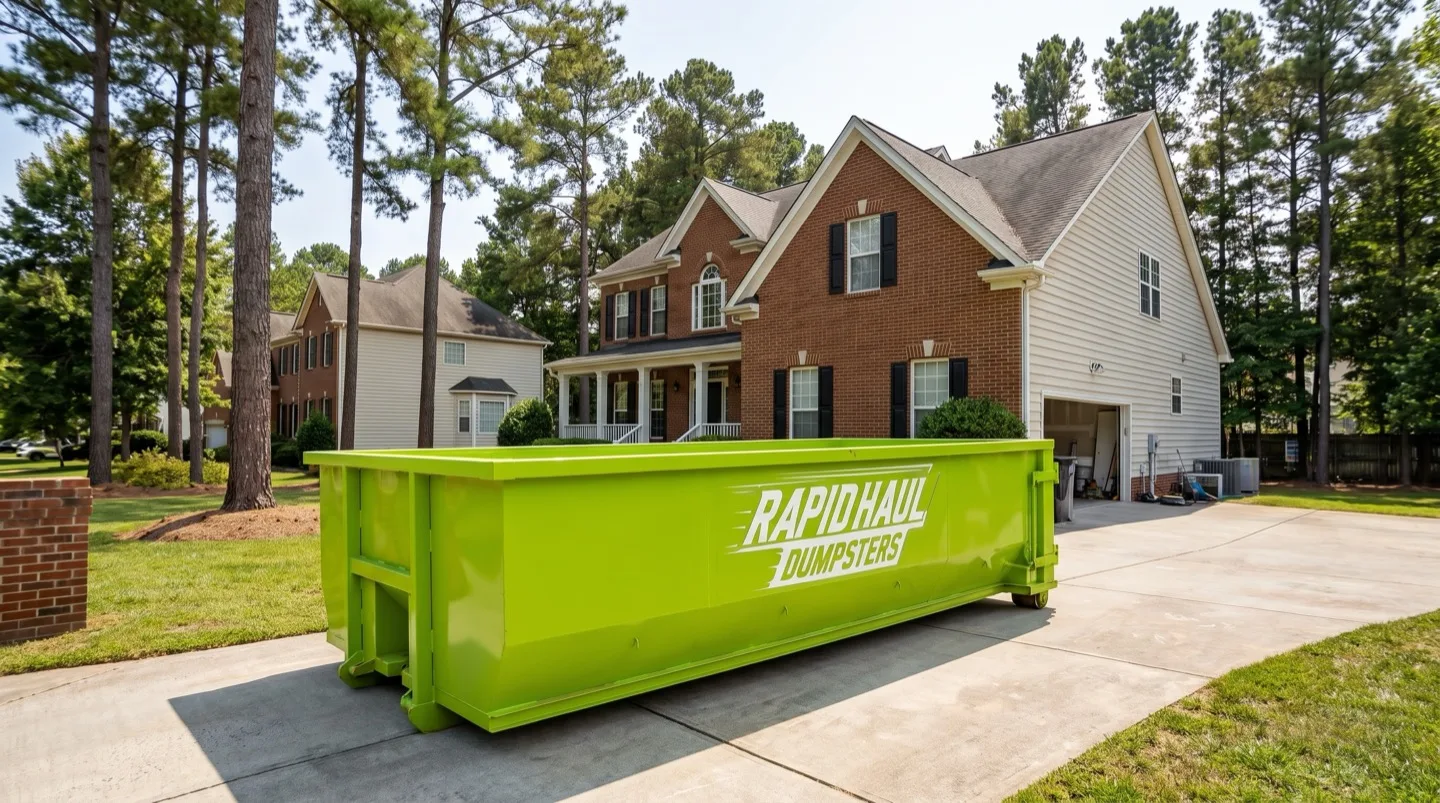
The 20-yard earns its “most popular” reputation because it is the smallest size that stops you from second-guessing. It is the container we deliver most often for residential jobs, thanks to its versatility and driveway-friendly footprint. It swallows a whole-house decluttering, a garage demolition, a large landscaping haul, or a residential roof tear-off without drama. If your project is a kitchen remodel, a multi-room cleanout, or anything where you cannot confidently say “this is small,” the 20-yard is the safer $50. You can compare the full price breakdown for both in our Charlotte dumpster rental cost guide.
20 vs 30-yard dumpster: when to size up
Step up from the 20-yard to the 30-yard when the project is a full gut renovation, a home addition, or anything that generates contractor-grade debris. The 30-yard holds 50 percent more than the 20 (30 cubic yards versus 20, about twelve pickup loads versus eight) for $95 more, and it drops your cost per cubic yard from $22.50 to $18.17, the best value of any residential size short of the 40.
The 30-yard’s extra two feet of height is the tell. It is built for volume that goes beyond a single room: home additions, multi-room renovations, and demolition projects that produce substantial debris. If a contractor is hauling demo material to the container across a multi-day job, the 30 keeps the work moving without anyone waiting on disposal capacity. The per-yard math is the clearest argument for sizing up, so here it is across all four containers.
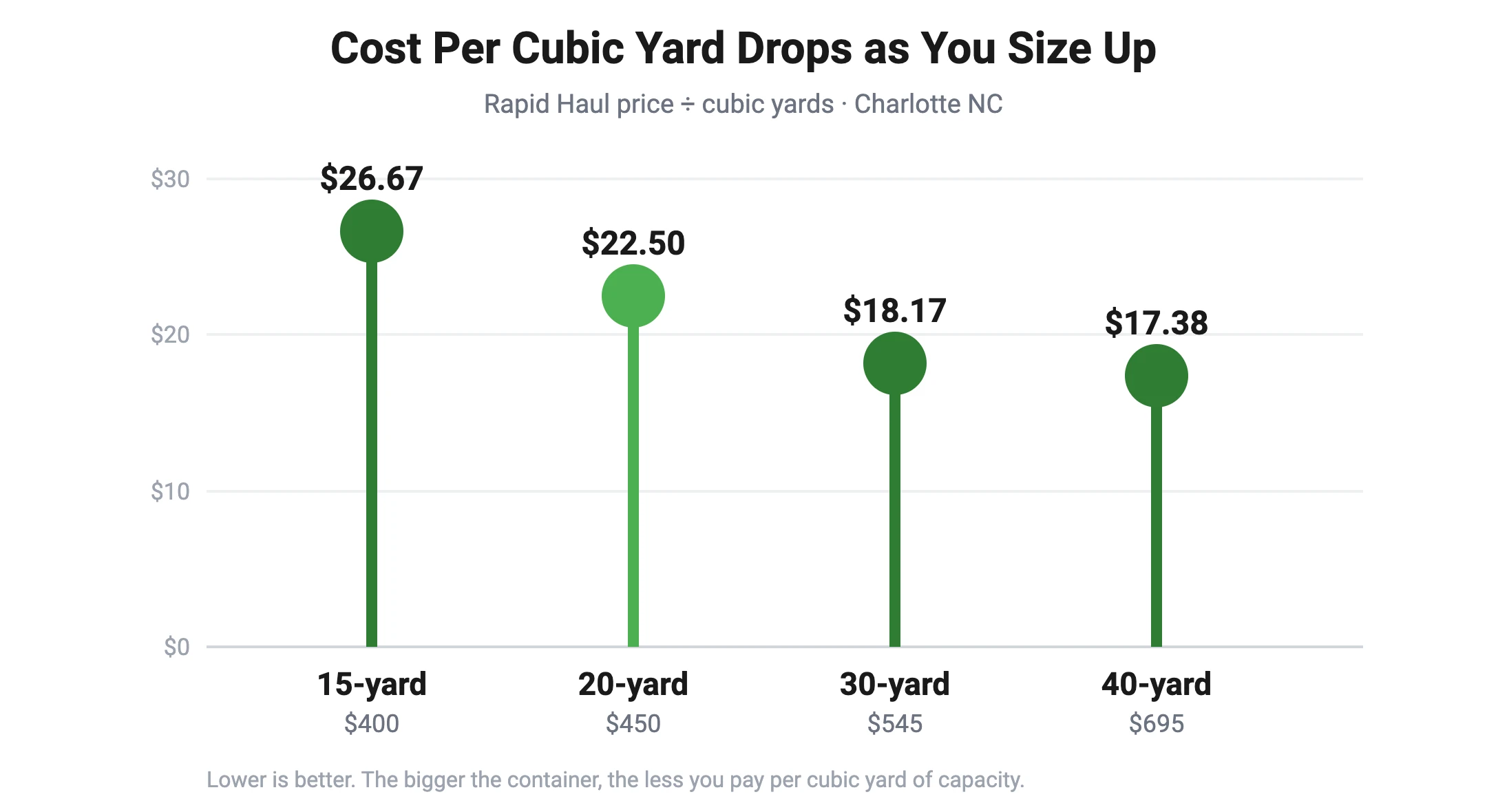
That said, do not size up on price alone. A 30-yard only saves you money if you actually fill it; renting 30 cubic yards for a 15-yard job means paying $545 to throw away air. The right move is to estimate your volume honestly against the project picks below, then choose the smallest container that holds it. The per-yard discount is a tiebreaker for when you are genuinely between two sizes, not a reason to default to the biggest box. For most homeowners the real decision is 15 versus 20; the 30 enters the conversation only for true renovation and construction scope.
What size dumpster for your project?
Match the container to the debris volume, not the room count. A bathroom generates about 1.5 cubic yards, a kitchen taken to the studs runs about 12.5 cubic yards, and a full-house gut or new-construction job can fill 30 cubic yards or more. The trick is to walk the project before you book: count the rooms involved, picture the debris as pickup-truck loads against the capacity table above, then round up to the next size whenever you land on a boundary. Estimating high by one size costs $50 to $95; estimating low costs a second haul. Here is how Charlotte’s most common projects map to Rapid Haul sizes.
| Project | Recommended size | Why |
|---|---|---|
| Bathroom remodel | 15-yard | ~1.5 cu yd of debris; smallest container is plenty |
| Single-room or flooring tear-out | 15-yard | One contained room of debris fits comfortably |
| Kitchen remodel (to studs) | 15 or 20-yard | ~12.5 cu yd; 20 adds a safety margin for cabinets |
| Roof tear-off (single layer) | 20-yard | Shingle weight, not volume, is the limit (see below) |
| Whole-house cleanout | 20-yard | Furniture and junk from a full home fits one 20 |
| Garage demolition / large landscaping | 20-yard | Bulky, mixed material in one weeklong haul |
| Home addition / multi-room gut reno | 30-yard | Contractor-grade volume across several rooms |
| New construction / full demolition | 40-yard | Largest size for the biggest cleanup jobs |
Roofing deserves its own note because it is the project most often sized wrong. Roofers measure in “squares,” where one square equals 100 square feet of roof, and a single square of asphalt shingles weighs 230 to 250 pounds for three-tab and 400 to 430 pounds for architectural shingles, weights we confirm on the scale ticket for every roofing load. A typical 2,000 to 2,500 square-foot Charlotte roof is 20 to 25 squares, which fits a 20-yard on volume but can bump against the weight limit on a tear-off, especially with a second layer underneath. That is why the 20-yard, not a bigger box, is the standard residential roof container: you are managing weight, not running out of room.
Don’t forget weight: heavy debris changes the math
Volume picks your size, but weight can override it. Every Rapid Haul container includes a weight allowance (1.5 tons on the 15-yard up to 4 tons on the 40), and going over costs $100 per ton on the scale ticket. With dense material like concrete, dirt, or shingles, you will hit that weight limit long before the box looks full, so the cubic-yard rating stops being the deciding number.
Here is how fast heavy debris adds up. These are per-cubic-yard weights for common materials, so you can sanity-check a load before it ends up costing more than you planned.
| Material | Weight per cubic yard | What that means |
|---|---|---|
| Solid concrete | ~4,050 lb (2 tons) | ~1.5 cu yd hits a 15-yard’s limit |
| Broken concrete / asphalt | ~2,025 lb (1 ton) | ~3 cu yd hits a 15-yard’s limit |
| Dirt (wet) | ~3,000 lb | A few yards maxes most sizes on weight |
| Gravel / rock | ~3,000 lb | Heavy; spread across the floor, don’t pile |
| Dirt (dry) | ~2,000 lb | Still a 1-ton-per-yard material |
The takeaway: for clean-out and renovation debris (furniture, drywall, cabinets, wood, general junk), size on volume using the picks above. For heavy material (concrete, dirt, brick, tile, roofing), size on weight and expect to only partially fill the container. Put simply, your debris can fit within the volume of the container while still exceeding its weight limit, which is exactly why Rapid Haul publishes the included tonnage up front and bills any overage transparently at $100 per ton rather than guessing at the curb.
Common dumpster sizing mistakes
The most expensive sizing mistake is going one size too small to save $50, then paying for a second haul or a swap-out that costs far more than the upgrade would have. When you are genuinely between two sizes for a volume-based job, size up; the per-cubic-yard cost drops as the container grows, so the bigger box is often cheaper per yard anyway.
A few other traps worth dodging before you book:
- Sizing a heavy load by volume. Concrete, dirt, and shingles hit the weight limit before they fill the box. Use the weight table above, not the cubic-yard rating, for dense debris.
- Forgetting the fill line. Drivers cannot legally haul a container loaded above the rim, so that extra foot of “space” on a 40-yard is not usable. Plan to load level, not heaped.
- Over-buying on the per-yard discount. A 30 or 40-yard is only cheaper per cubic yard if you fill it. For a one-room job, the 15-yard is the cheaper total even at a higher per-yard rate.
- Ignoring driveway access. All four sizes need roughly 60 feet of straight clearance to drop and retrieve. The size you pick rarely changes whether the truck can reach the spot, but the spot itself can, and if the container has to sit on the street instead of the driveway you may need a Charlotte right-of-way permit.
When in doubt, describe your project to us and we will tell you the honest size, even if it is the smaller one. Rapid Haul delivers all four sizes across Charlotte and the surrounding communities with same-day service, so there is no penalty for asking before you commit. If you would rather see the reasoning behind each project recommendation, our complete Charlotte sizing guide goes deeper on cubic-yard estimates by job type.
Not sure which size fits your Charlotte project?
Tell us what you’re hauling and we’ll recommend the right roll-off, then deliver it the same day. Rentals start at $400 with 7 days included.
Book your dumpster
or call 833-DUMP-365
Frequently asked questions
What is the difference between a 15 and 20-yard dumpster?
Is a 20-yard dumpster worth it over a 15-yard?
What size dumpster do I need for a roof tear-off?
How many pickup truck loads fit in a 20-yard dumpster?
Do I need a 30-yard dumpster for a full-house renovation?
The bottom line
Size on volume first, weight second. A 15-yard ($400) handles one contained room or cleanout, a 20-yard ($450) is the do-everything residential pick for roofs, garages, and whole-house projects, and a 30-yard ($545) is for gut renovations and contractor debris. When you are stuck between two, size up: the bigger container is cheaper per cubic yard and far cheaper than a second haul.
Rapid Haul delivers all four sizes across Charlotte the same day, with 7 days of rental, delivery, pickup, and tonnage included in the price. See full pricing, match a size to your project, or call 833-DUMP-365 and we’ll get the right roll-off to your door.